
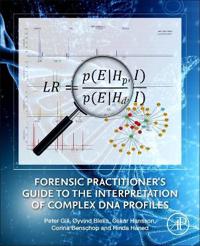

Over the past twenty years, there’s been a gradual shift in the way forensic scientists approach the evaluation of DNA profiling evidence that is taken to court. Many laboratories are now adopting ‘probabilistic genotyping’ to interpret complex DNA mixtures. However, current practice is very perse, where a whole range of technologies are used to interpret DNA profiles and the software approaches advocated are commonly used throughout the world. Forensic Practitioner’s Guide to the Interpretation of Complex DNA Profiles places the main concepts of DNA profiling into context and fills a niche that is unoccupied in current literature. The book begins with an introduction to basic forensic genetics, covering a brief historical description of the development and harmonization of STR markers and national DNA databases. The laws of statistics are described, along with the likelihood ratio based on Hardy-Weinberg equilibrium and alternative models considering sub-structuring and relatedness. The historical development of low template mixture analysis, theory and practice, is also described, so the reader has a full understanding of rationale and progression. Evaluation of evidence and statement writing is described in detail, along with common pitfalls and their avoidance. The authors have been at the forefront of the revolution, having made substantial contributions to theory and practice over the past two decades. All methods described are open-source and freely available, supported by sets of test-data and links to web-sites with further information. This book is written primarily for the biologist with little or no statistical training. However, sufficient information will also be provided for the experienced statistician. Consequently, the book appeals to a perse audience
Handlekurven din
Alle bestillinger vil bli brukt
USD.
Innholdet i din nåværende handlekurv vises
CYN,
Du vil bruke
USD
Beregnet med siste valutakurs.
utsolgt
Noen produkter er ikke lenger tilgjengelige. Handlekurven din er oppdatert.
Har du en rabattkode?

tupp

Fraktforsikring
Delsum
Rabatt
Denne rabattkoden kan ikke brukes i forbindelse med andre kampanjer eller rabatttilbud.
total
Beregn avgifter og fraktkostnader ved betaling.
Kommentar